
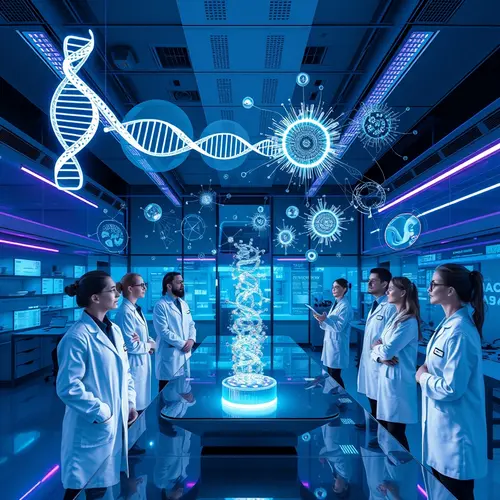

What Defines New and Emerging Technology
A technology qualifies as “emerging” when it demonstrates three core characteristics: it’s still developing beyond proof-of-concept, it shows exponential improvement potential, and it threatens to disrupt established markets or create entirely new ones.This definition excludes incremental improvements to existing systems. We’re talking about foundational shifts—technologies that change the rules rather than optimize within them.The maturity curve matters. Technologies move through distinct phases: research and development, early adoption, scaling challenges, and eventual mainstream integration. Recognizing where a technology sits on this curve informs investment decisions, strategic planning, and risk assessment.New and Emerging Technology – Core Categories Reshaping Industries
New and Emerging Technology – Artificial Intelligence and Machine Learning
AI systems have evolved beyond simple pattern recognition. Deep learning architectures now handle multi-modal data processing, generating insights from combinations of text, image, and sensor data simultaneously.The practical impact shows up in drug discovery timelines compressed from years to months, predictive maintenance systems that prevent equipment failures before they occur, and natural language processing that understands context and nuance.According to research from leading tech institutions, neural network architectures continue advancing at rates that outpace Moore’s Law predictions. The key isn’t just processing power—it’s architectural innovation and training methodology refinement.New and Emerging Technology – Quantum Computing Fundamentals
Quantum systems leverage superposition and entanglement to perform calculations impossible for classical computers. This isn’t about speed alone—it’s about solving problem classes that conventional architecture can’t address.Applications center on optimization problems: molecular simulation for materials science, cryptographic systems, financial modeling, and supply chain logistics. The technology remains in early stages, with error correction and qubit stability presenting ongoing challenges.New and Emerging Technology – Biotechnology and Genetic Engineering
CRISPR gene editing, synthetic biology, and personalized medicine platforms represent the convergence of biology and information technology. These tools enable precise genetic modifications, custom organism design, and treatment protocols tailored to individual genetic profiles.The implications extend beyond healthcare into agriculture, environmental remediation, and manufacturing. Engineered organisms can produce materials, clean contaminated sites, or create sustainable alternatives to petroleum-based products.| Technology Domain | Maturity Level | Primary Applications | Key Challenge |
|---|---|---|---|
| Artificial Intelligence | Scaling Phase | Automation, Analysis, Generation | Interpretability & Bias |
| Quantum Computing | Early Development | Optimization, Simulation | Error Correction |
| Biotechnology | Clinical/Field Testing | Medicine, Agriculture | Regulatory Frameworks |
| Advanced Materials | Prototype Phase | Energy, Manufacturing | Production Scaling |
Implementation Strategies for Organizations
Adopting new and emerging technology requires methodical evaluation. Start by identifying specific problems these tools can solve rather than chasing novelty for its own sake.Run controlled pilots before full deployment. Test assumptions, measure outcomes against clear metrics, and build internal expertise through hands-on experience. Partner with specialized vendors or research institutions to accelerate learning curves.Budget for iteration. First implementations rarely deliver optimal results. Plan for refinement cycles, data quality improvements, and infrastructure adjustments.Risk Mitigation and Governance
Establish clear guidelines for new and emerging technology deployment. Define acceptable use cases, data handling protocols, and decision-making boundaries.Security considerations multiply with emerging systems. Novel attack vectors emerge alongside new capabilities. Conduct thorough threat modeling and implement defense-in-depth strategies.Regulatory compliance varies by sector and geography. Stay informed about evolving standards, particularly in heavily regulated industries like healthcare, finance, and transportation.Expert Analysis: Common Misconceptions
One persistent myth holds that emerging technologies replace human expertise. The reality shows augmentation rather than replacement. AI systems excel at pattern recognition and data processing but lack contextual judgment and creative problem-solving.Another misconception treats all emerging tech as equally mature or accessible. Technologies differ dramatically in readiness, cost, and implementation complexity. Quantum computing remains largely experimental while AI tools have reached production-grade stability in many domains.The “winner takes all” assumption overlooks how technologies often coexist and complement each other. Multiple competing approaches can thrive simultaneously, each optimized for different use cases or constraints.Practical Application Framework
When evaluating new and emerging technology opportunities, use this systematic approach:- Map the technology to specific business objectives with quantifiable success metrics
- Assess internal capability gaps and required skill development investments
- Analyze total cost of ownership including infrastructure, training, and ongoing maintenance
- Identify dependencies on external vendors, platforms, or data sources
- Model scenarios for both successful adoption and potential failure modes
- Establish clear exit criteria and contingency plans
Looking Forward: Strategic Positioning
Organizations that thrive with new and emerging technology share common traits. They maintain experimental capacity separate from operational systems, allowing exploration without risking core business functions.They build diverse teams combining domain expertise with technical capability. The best implementations emerge from tight collaboration between those who understand the problem space and those who understand the technology.They stay connected to research communities, industry consortiums, and standards bodies. Early awareness of technological developments creates competitive advantage through faster adaptation and strategic positioning.The trajectory of new and emerging technology points toward increasing integration across domains. The boundaries between digital and physical systems blur. Biology becomes programmable. Materials science merges with information technology. Success requires understanding not just individual technologies but how they combine and amplify each other’s capabilities.
Nisa Kure
Nisa Kure is a senior tech reviewer at Fabrikant Tech testing phones, SSDs, wearables, and smart-home gear. 5+ years, 200+ hands-on reviews. Method: 2-week daily use, benchmarks, and thermal logs. Author of 840 tech guides since 2022.


More Stories
7 Latest Technological Advancements Reshaping Our World
Latest Technology in Computer: Ultimate Guide
Advanced Technology Examples: 10 Real-World Applications