
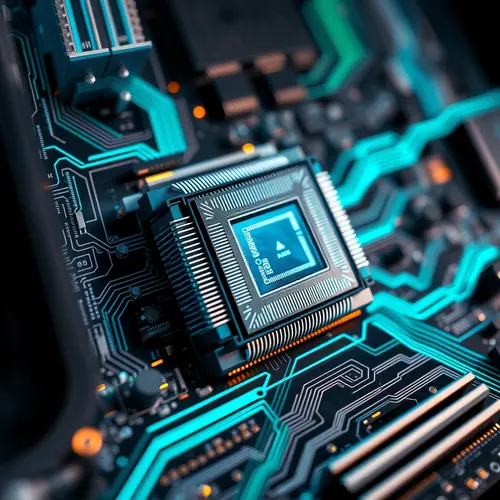

Understanding the Latest Technology in Computer Hardware
Silicon innovation has moved beyond traditional CPU scaling. The semiconductor industry now focuses on heterogeneous computing architectures where multiple processor types work in tandem. Application-specific integrated circuits (ASICs) designed for machine learning tasks deliver orders of magnitude better performance-per-watt compared to general-purpose processors.Neuromorphic chips mimic biological neural networks at the hardware level. Unlike conventional processors that separate memory and computation, these systems integrate both functions. This architecture reduces data movement, which represents the primary energy cost in traditional computing. According to research published by major semiconductor manufacturers, neuromorphic designs can achieve up to 100x better energy efficiency for specific workload patterns.Latest Technology in Computer – Advanced Processing Unit Architectures
Graphics processing units (GPUs) have evolved into general-purpose accelerators. Modern GPU architecture incorporates tensor cores specifically optimized for matrix multiplication operations that dominate deep learning algorithms. A single high-end GPU can execute thousands of parallel operations simultaneously, making it indispensable for training large language models and computer vision systems.Data processing units (DPUs) represent another specialization. These chips offload networking, storage, and security tasks from the CPU. By handling infrastructure tasks at line rate, DPUs free compute resources for application workloads. This separation of concerns dramatically improves total system efficiency in cloud and edge computing environments.Memory and Storage Breakthroughs in Latest Technology in Computer Systems
High-bandwidth memory (HBM) stacks memory dies vertically and connects them to the processor through thousands of microscopic connections. This 3D integration delivers bandwidth exceeding 1 terabyte per second while consuming less power than traditional memory architectures. The proximity of memory to processing cores reduces latency, which directly translates to faster computation.| Technology Type | Primary Advantage | Typical Use Case | Performance Metric |
|---|---|---|---|
| HBM3 Memory | Bandwidth & Efficiency | AI Training | 819 GB/s per stack |
| PCIe Gen 5 Storage | Sequential Speed | Data Centers | 14 GB/s read/write |
| CXL Interconnect | Memory Pooling | Cloud Infrastructure | 64 GB/s bidirectional |
| Persistent Memory | Byte-addressable Storage | Database Systems | Sub-microsecond latency |
Latest Technology in Computer – Storage Interface Evolution
Compute Express Link (CXL) fundamentally changes how systems share memory across devices. This open standard allows CPUs, GPUs, and accelerators to access a shared memory pool with cache coherency. Instead of copying data between isolated memory spaces, devices can directly access the same memory addresses. This eliminates redundant data movement and enables larger effective memory capacities.Non-volatile memory express (NVMe) over fabrics extends storage networks beyond single servers. By using RDMA (remote direct memory access) protocols, systems can access remote storage with latency approaching local SSD performance. This technology enables disaggregated storage architectures where compute and storage scale independently.Latest Technology in Computer – Quantum Computing Integration
Quantum processors operate on fundamentally different principles than classical computers. While conventional bits exist as either 0 or 1, quantum bits (qubits) exist in superposition states. This property allows quantum computers to explore multiple solution paths simultaneously. The latest technology in computer science demonstrates how hybrid classical-quantum systems tackle optimization problems that would take classical computers millennia to solve.Quantum error correction remains the primary technical challenge. Qubits are extremely fragile and lose their quantum state through decoherence. Modern systems use logical qubits constructed from multiple physical qubits with error-correction codes. As qubit counts increase and error rates decrease, practical applications expand beyond research laboratories into domains like drug discovery and financial modeling.Practical Applications of Latest Technology in Computer Innovations
These hardware advances enable entirely new categories of applications:- Real-time language translation: Specialized neural processing units handle translation with latency low enough for natural conversation flow.
- Autonomous system perception: Vehicle computers process multiple high-resolution camera feeds and LIDAR data streams simultaneously to build environmental models.
- Scientific simulation: Researchers run molecular dynamics simulations at scales previously impossible, accelerating drug development timelines.
- Edge AI deployment: Low-power inference accelerators bring sophisticated models to devices without cloud connectivity requirements.
- Cryptographic security: Quantum-resistant algorithms run on specialized hardware to protect against future quantum computer attacks.
Latest Technology in Computer – Energy Efficiency Considerations
Power consumption defines the practical limits of computational scaling. Data centers consume approximately 1% of global electricity, according to International Energy Agency assessments. The latest technology in computer hardware addresses this through multiple approaches.Liquid cooling systems remove heat more efficiently than air cooling. Direct-to-chip liquid cooling uses cold plates mounted directly on processors, eliminating the thermal interface resistance of heat sinks. This enables higher sustained clock speeds while reducing fan power consumption. Some facilities use immersion cooling where entire servers operate submerged in dielectric fluid.Latest Technology in Computer – Debunking the Backward Compatibility Myth
A common misconception holds that new processor architectures break software compatibility. The reality is more nuanced. While instruction set architecture (ISA) changes can require recompilation, modern systems maintain backward compatibility through translation layers and microcode.ARM processors, which dominate mobile and increasingly challenge x86 in data centers, run legacy software through emulation with minimal performance penalty. Apple’s transition from x86 to ARM demonstrates how translation technology (Rosetta 2) makes architectural shifts transparent to most users. The performance benefits of modern architectures typically outweigh any translation overhead.Latest Technology in Computer – Expert Perspective on Overlooked Innovations
The most underappreciated advancement in the latest technology in computer systems is chiplet architecture. Instead of building monolithic processors, manufacturers now combine multiple smaller chips (chiplets) on a single package. This approach improves manufacturing yield since defects affect only individual chiplets rather than entire dies.Chiplet designs also enable mix-and-match configurations. A system-on-package might combine CPU chiplets built on one manufacturing process with GPU chiplets from a different process node, each optimized for its specific workload. This modularity accelerates innovation cycles and reduces development costs compared to redesigning monolithic chips.Latest Technology in Computer – Implementation Considerations for Organizations
Adopting the latest technology in computer infrastructure requires careful analysis. Organizations should evaluate workload characteristics before investing in specialized hardware. AI accelerators deliver exceptional performance for neural network training but provide no benefit for traditional database operations.Total cost of ownership extends beyond purchase price. Consider power consumption, cooling infrastructure requirements, and software ecosystem maturity. A processor with lower theoretical performance but broader software support may deliver better practical results than cutting-edge hardware with immature tool chains.Latest Technology in Computer – Migration Strategy Framework
Successful technology adoption follows a phased approach. Start with pilot projects on non-critical workloads to understand performance characteristics and identify integration challenges. Measure actual improvements rather than relying on vendor benchmarks, which often use optimized scenarios unrepresentative of real workloads.Build internal expertise before large-scale deployment. Training teams on new architectures and programming models prevents costly mistakes and ensures optimal utilization. Many organizations discover that software optimization on existing hardware delivers better ROI than premature hardware upgrades.Latest Technology in Computer – The Future Trajectory of Computing Hardware
The semiconductor industry faces fundamental physical limits. Transistor dimensions approach atomic scales where quantum effects dominate. Future progress depends less on pure miniaturization and more on architectural innovation, 3D integration, and specialized acceleration.Photonic interconnects replace electrical connections with light, dramatically increasing bandwidth while reducing power consumption. Silicon photonics integrates optical components directly on processor packages, eliminating electrical-to-optical conversion bottlenecks. This technology enables rack-scale computers where thousands of processors communicate at terabit speeds.The latest technology in computer systems reflects a broader shift from general-purpose computing toward heterogeneous, specialized architectures. Understanding these technologies and their practical implications positions organizations to make informed infrastructure decisions that align with actual workload requirements rather than marketing hype.
Nisa Kure
Nisa Kure is a senior tech reviewer at Fabrikant Tech testing phones, SSDs, wearables, and smart-home gear. 5+ years, 200+ hands-on reviews. Method: 2-week daily use, benchmarks, and thermal logs. Author of 840 tech guides since 2022.


More Stories
5 Foundational Information Technology Trends You Can’t Ignore
7 Latest Technological Advancements Reshaping Our World
Advanced Technology Examples: 10 Real-World Applications